
How Dropbox got its first users with a rough screencast and a bag of Easter eggs
Posted a rough screencast on Hacker News to get feedback before the product was finished

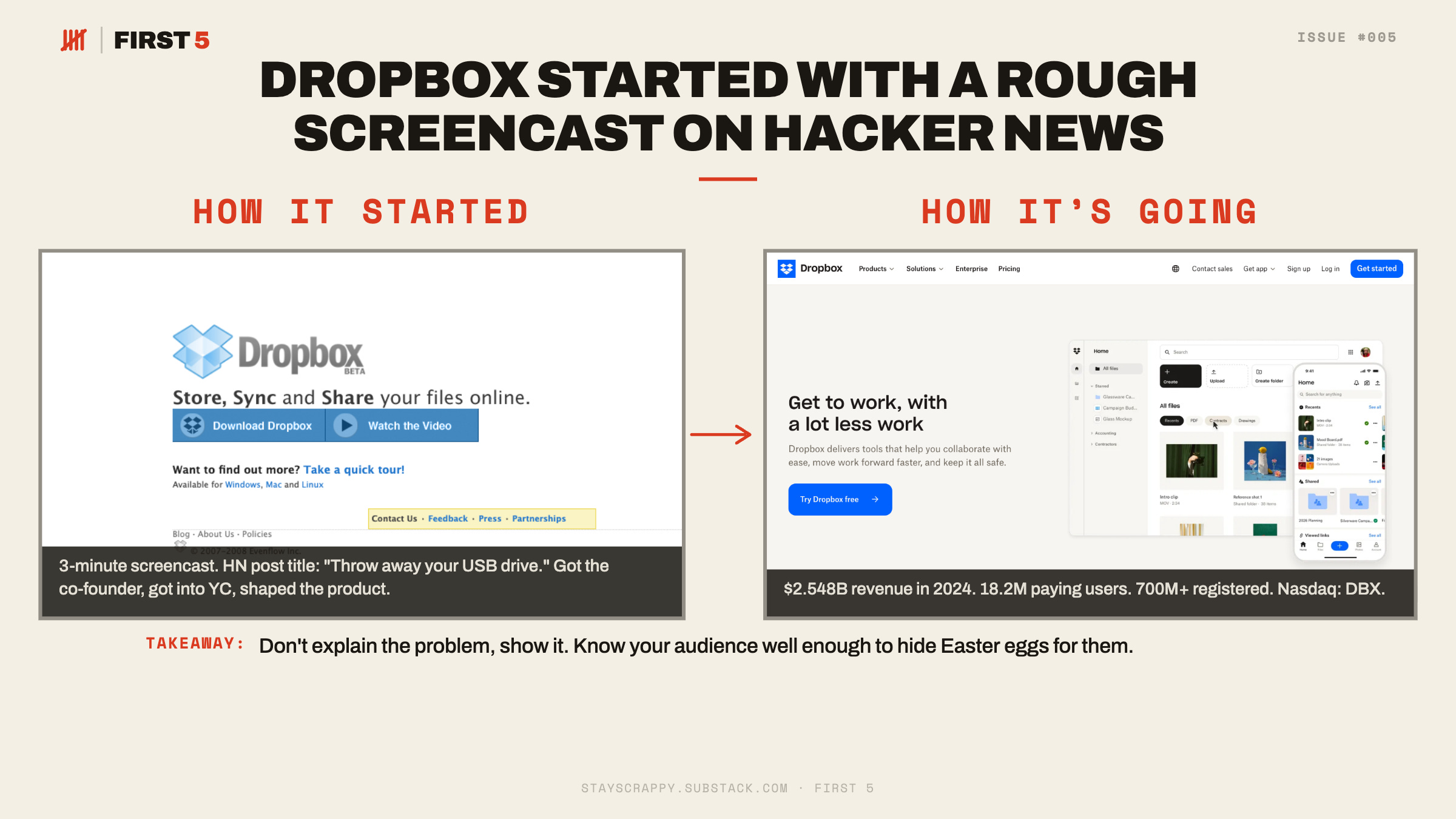
Drew Houston forgot his USB drive on a bus from Boston to New York. So he started building the thing that would make USB drives obsolete, right there on the bus.
The story: Dropbox
Who they were. Drew Houston, a recent MIT grad, building a file sync tool that would make your files magically available everywhere. The problem was deeply felt by anyone who’d ever emailed themselves a document or named a file “proposal v2 good revised NEW 11-15-06.doc”. The audience was developers and tech-savvy early adopters who already sensed the answer had to exist.
The channel. Hacker News, in April 2007, before Hacker News was even called Hacker News. It was called Startup News.
The move. Houston had a working prototype but not a finished product. Rather than wait, he recorded a rough three-minute screencast showing how it worked and posted it with the title “My YC app: Dropbox. Throw away your USB drive.” He was applying for Y Combinator and wanted feedback. He got it, starting with a comment telling him not to bother.
Original Screencast
The original HN post, April 4–5, 2007. Still live at news.ycombinator.com/item?id=8863
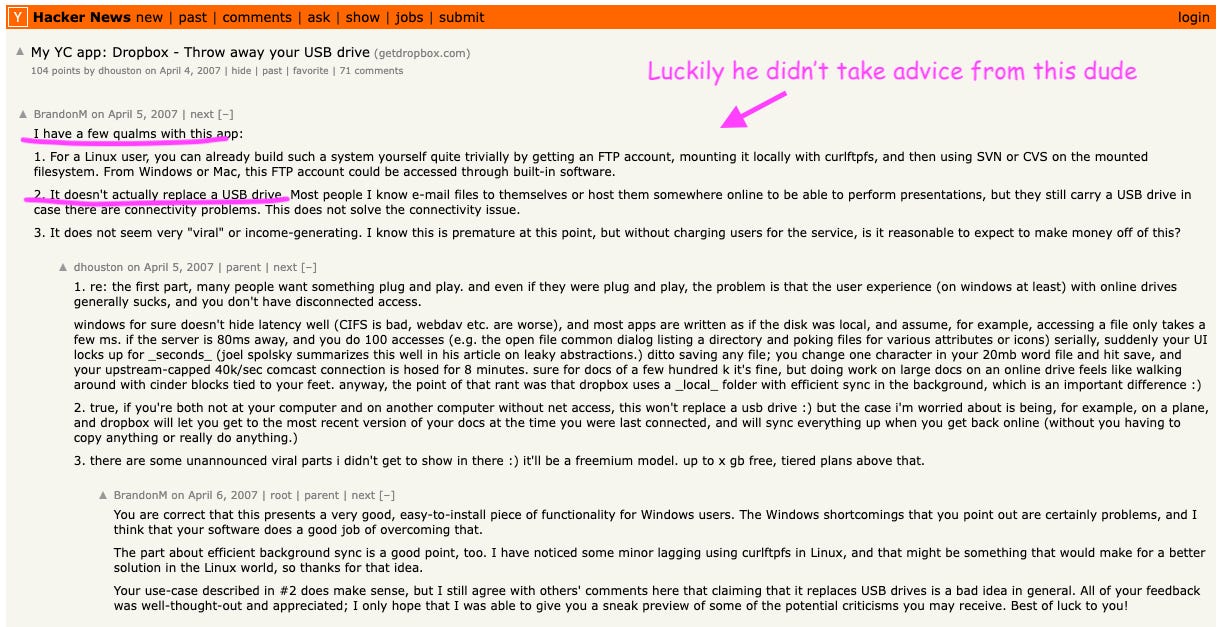
The very first reply, from a user called BrandonM, said Dropbox was pointless. You could already build the same thing yourself: get an FTP account, mount it locally with curlftpfs, then run SVN or CVS on top of it for version history. Why would anyone need a product for something an engineer could wire up with tools that already existed.
Houston’s reply is the whole lesson. He didn’t argue the engineering. He pointed out who the DIY version was actually for. Online drives felt awful to use because Windows and Mac apps assumed the disk was local. Every file open, every save, every icon lookup turned into a round trip to a server, and on a slow connection that meant your screen locking up for minutes over a file a few hundred kilobytes in size. Dropbox synced a folder that lived on your machine in the background, so it worked the same whether you were online or on a plane with no signal at all. The FTP and SVN combo was a real fix, but only for someone willing to assemble it. Most people emailing themselves attachments were never going to do that. They just wanted their files to be there.
That’s the difference between solving a problem and solving it for the people who actually have it. The engineers on that thread already had a workaround. They were not the customer. The customer was everyone who didn’t know what curlftpfs was and never would, and the win was making something that complicated disappear behind one folder that just worked.
That thread mattered for another reason too. The right people were there even if some of them were wrong about who needed this. It lit up with technical feedback from developers who wanted this to exist. That feedback shaped the product.
That same post attracted Arash Ferdowsi. He saw the demo, left MIT’s Masters program, and became Dropbox’s co-founder and CTO. Drew put one thing in front of the right people, and the right person showed up.
That got them into YC Summer 2007 and gave them a co-founder.
Then came the second move. In March 2008, Houston made another video for the private beta launch. He posted it on Digg under the headline “Google Drive killer coming from MIT Startup.” But here is what most people miss: he packed about a dozen Easter eggs into the video, references to Tay Zonday and Chocolate Rain, nods to Office Space, XKCD comics. Things the Digg and Reddit crowd would catch and grin at. The video picked up 12,000 Diggs. The beta waitlist jumped from 5,000 to 75,000 in one day.
Two moves. Same principle both times: go to the exact community that already feels the pain, and speak their language.
What it cost. One screencast, a YC application, and enough homework on the Digg community to know what they found funny.
The lesson. Show the magic before the product is finished. If you know a specific community that already feels your problem, you don’t need a product launch, you need one honest demo in the right room. And when the smartest people in that room tell you the problem is already solved, look at who they mean by “you.” An engineer with an FTP account and curlftpfs was never your customer. The person who just wants their file to be there was.
What you can steal
Your potential users are probably gathering somewhere right now, talking about exactly the problem you solve. A forum, a Slack, a subreddit, a corner of Hacker News. You don’t need a finished product to show them something real.
Watch who tells you not to bother. If it’s someone who can already patch together their own fix with tools you’d need a manual to explain, that’s not your customer talking, that’s someone who was never going to feel the pain the way your real user does. The simplest problems are often the ones nobody with technical skill takes seriously, because they can solve it themselves in ten minutes. That gap between “I can hack this together” and “I just want this to work” is where a lot of real businesses hide.
Where is the one community that already feels your pain? And what would you put in your version of the video to make them feel like you made it specifically for them?
Got your own first 5 story? Hit reply and tell me how you landed your earliest customers. The channel, the message, what you did. I feature real founders here and yours could be next. Or submit it here
And if this was useful, forward it to a builder who is stuck staring at an empty dashboard.
Stay scrappy,
Gary